
What a Sacramento County Resident Lookup Can Confirm
A resident lookup is a source-selection problem. The record type below sets the strength and meaning of the result. A public owner field is not the same as a current occupant. A court party is not the same as a defendant or witness in every matter. A last-known address in a state database is not a present residence.
| Record | What It Confirms | Where and Coverage | Access |
|---|---|---|---|
| Assessor roll | Ownership, mailing and situs fields, values and exemptions | Current county roll | Viewer omits owner; lobby or request supplies public fields |
| Recorded documents | Named party's land or lien transaction | Index from 1849; recorded documents from 1850 | Free index; paid or office image |
| Superior Court | Party name, role, case type, dates, docket and status | Criminal 1989-present; civil and probate split ranges | Portal, account, kiosk, or counter |
| Vital records | Birth, death, marriage, or dissolution event | County and statewide custodians | Eligibility-based copy request |
| Business or license record | Affiliation, filing, status, or address of record | California and county systems | Free search with scope limits |
| Probate or unclaimed property | Estate role, heir clue, or reported last-known address | Historical/current court or statewide controller | Portal, kiosk, copy request, or proof claim |
Choose the strongest source for the fact at issue, then use a second source to test identity. That is the core of a reliable Sacramento County resident lookup.
Defeat a Sacramento Same-Name Trap
Common names create false matches in every resident lookup. Normalize surname particles, hyphens, middle names, initials, former names, and trust or business forms. Search broadly first, then narrow by date, case role, city, APN, spouse or associate, and record type. A court hit without a matching date or second identifier is only a lead.
Sacramento's court systems make this discipline important. Criminal public access uses exact name criteria and reaches 1989 to the present. Civil, family, and probate results use their own portals and confidentiality rules. Traffic searches use a driver-license number, citation, or case number rather than a general name list. Small claims coverage begins after 1999 in the court's account system.
Do not treat a no-result screen as a universal negative. The case may be sealed, juvenile, restricted, off-site, outside the portal's date range, or filed under a different name. Record the search date and system used.
Read Sacramento Court Results by Role
The Sacramento Superior Court Case Search hub separates criminal, civil, family, probate, traffic, small claims, and limited civil matters. The new civil and probate case-management system went live April 24, 2023, and small claims and limited civil integration followed June 17, 2024. The court's portal migration information explains coverage cutoffs and kiosk access. A new account is required for the account portal. Courthouse kiosks can expose more public information than the remote viewer.
Criminal name access is provided through the court's Criminal Public Case Access. Civil viewing and copy questions go through the Civil Records unit, where older files and remote-document limits are described.
Federal matters for the Eastern District of California are separate from Sacramento Superior Court. PACER requires an account and supports court, case, and party searches under federal access rules.
A result can show a caption, party names and roles, case number, matter type, filing date, register-of-actions events, hearings, and disposition or status. Public civil PDFs may be viewed, saved, and printed for covered cases after November 13, 2007, while confidential or sealed material stays gated. The court warns that a name result cannot make a fingerprint-based positive identity.
| Criminal search | Last name and first name, with exact criteria or case-number route; Sacramento filings from 1989 to the present. |
|---|---|
| Civil search | Account portal with party or case criteria; public cases initiated after November 13, 2007, plus historical index coverage. |
| Probate search | Account portal or historical name, case, and filing-date search; historical coverage from 1948 to 2007. |
| Family search | Name, case number, or filing date, subject to family-law confidentiality. |
| Traffic search | Driver-license number, citation, or case number rather than a general name directory. |
Open the Sacramento Superior Court historical case search for the older civil and probate ranges before interpreting a name result.
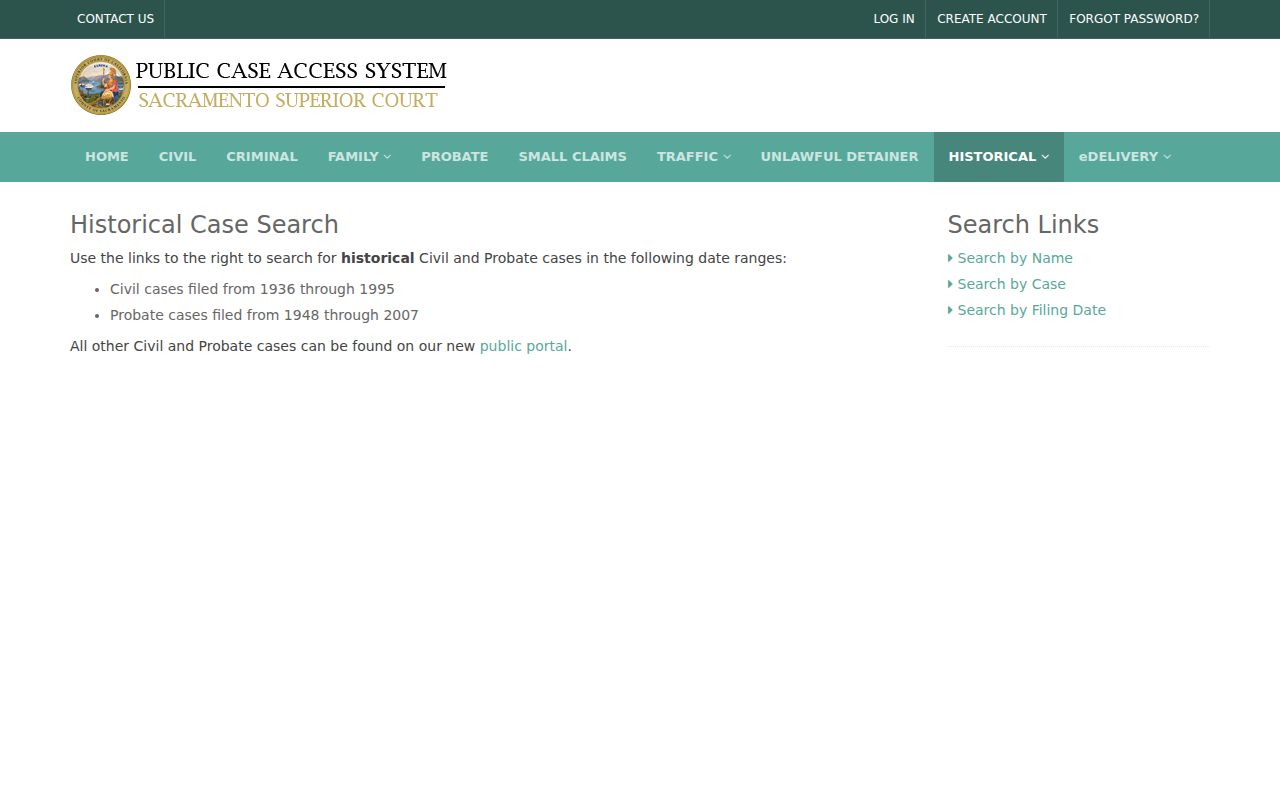
The historical search capture illustrates why the date range belongs beside the name. Civil coverage from 1936 to 1995 and probate coverage from 1948 to 2007 sit apart from the newer account system.
| Identity | Party name and role as recorded in the case. |
|---|---|
| Placement | Case number, filing date, division, and docket or register-of-actions entry. |
| Substance | Case type, hearings, status, disposition, and public document links where allowed. |
| Limit | Sealed, juvenile, family, probate, and party-only material may be withheld. |
Verify One Sacramento Resident in Steps
A useful resident lookup keeps the claim modest. The aim may be to anchor a name to an address, confirm a family event, identify an estate role, or reconnect a classmate. Begin with the record best matched to that aim, not the broadest search box.
- Write the exact name, known city or ZIP, approximate date, and reason for the search in private notes.
- Search the matching official source, keeping the case number, APN, property ID, edition year, or certificate reference.
- Compare a second identifier such as a middle name, date, spouse, address, business filing, or family relationship.
- Check whether the result is ownership, affiliation, a court role, a last-known address, or a current self-status result.
- Ask the custodian for a copy, correction, or access explanation when the source is incomplete.
- Docket
- The running case record of filings, events, hearings, and status entries.
- Index versus image
- An index points to a record; an image or certified copy contains the document itself.
- Certified copy
- A copy issued with a custodian's certification, often subject to a fee and eligibility rule.
- Disposition
- The recorded outcome or status of a case, not a complete account of every allegation.
Authorized and Informational Vital Copies
California Health and Safety Code sections 103525 through 103526 distinguish authorized certified copies from certified informational copies. A qualifying person may request an authorized copy. Other requesters can generally seek an informational birth or death copy marked as not valid to establish identity. Confidential marriage records are restricted under Family Code section 511, and adoption originals remain sealed unless a statutory or court process opens a path.
Sacramento County charges $34 for a birth copy, $26 for death, and $19 for marriage. Local Vital Records handles births and deaths from the past two years at 7001-A East Parkway, Suite 650, Sacramento, Monday through Friday from 8 a.m. to 4 p.m., with phones to 4:30 p.m., at (916) 875-5345. Older or uncertain events can move to the Clerk/Recorder or California CDPH Vital Records. The current state vital-record fee table lists the 2026 amounts: $31 birth, $26 death, $19 marriage, and $18 dissolution certificate.
The CDPH VS 111 birth application asks for the applicant's relationship and purpose, the registrant's full birth details, parent information, copies requested, signature, and payment. Authorized mail requests require a government photo ID and notarized sworn statement. No-record fees are retained.
Find an Heir Through Sacramento Probate
Probate can connect a decedent, representative, heir, and address when the public filing is available. Sacramento Superior Court, not the Clerk/Recorder, holds probate. The historical probate search covers 1948 through 2007, while a newer account portal carries current matters. A will or petition may name heirs, representatives, and addresses, but sealed or confidential pages remain unavailable.
Use a case number whenever possible. Without one, the probate copy schedule lists a $15 search, $0.50 per page, $40 for certification plus pages, and $50 per case for exemplification plus pages. Probate help is (916) 875-3400, option 2, at the Probate division on 500 G Street in Sacramento. An heir clue should be tested against a deed, obituary, directory entry, or another public filing.
Business and License Affiliations
When a name is tied to a business rather than a household, use the official filing system. California Secretary of State Business Search covers domestic stock and nonprofit corporations, qualified foreign corporations, LLCs, and limited partnerships. The Secretary of State's business-search tips explain name and entity-number formats. Corporations use a C plus seven digits; LLC and LP numbers use 12 digits. General partnerships and LLPs are outside the search scope, and some images must be ordered.
Sacramento County fictitious-business-name filings can connect a trade name to a registrant and mailing or business address. Statements normally expire after five years, so an absence can reflect a variant, another county, an expired filing, or a different entity type. The California Department of Consumer Affairs license search spans participating boards, while board-specific systems cover areas such as contractors, real estate, medical, nursing, and cosmetology. A license address is an address of record and not residential proof.
Unclaimed Property Is a Weak Address Clue
The California State Controller's Unclaimed Property search is a free name and locality lookup. A match can show a reporting holder, property ID, and a last-known address. It is useful for reconnecting with an old name or estate lead, but it does not prove present residence. A claim requires proof, and the official Controller channel should be used directly.
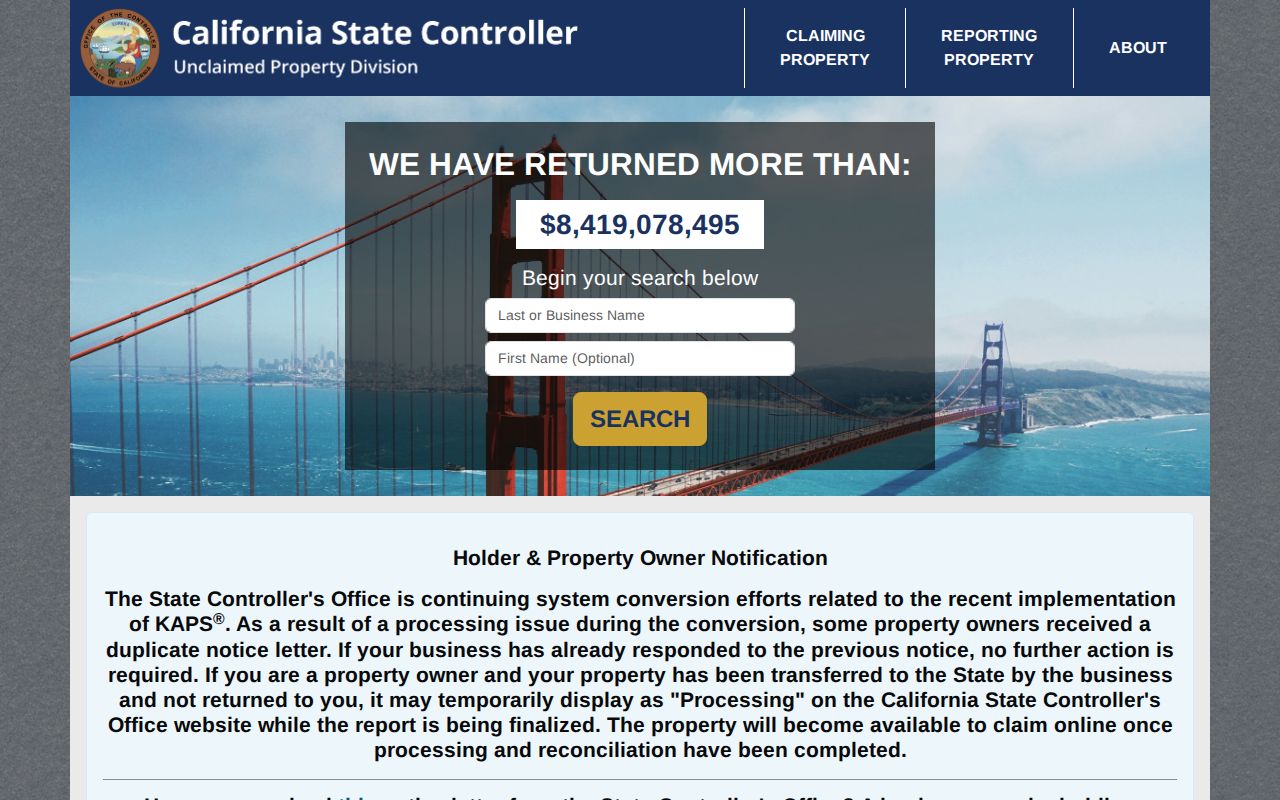
The unclaimed-property capture shows a name-search clue that must be separated from a current resident record. Keep the property ID and use it to build a lawful proof trail.
Other weak signals include professional licenses, business statements, obituaries, yearbooks, and cemetery material. Each can add context. None should be silently promoted to proof of where someone lives now.
When a Sacramento Lookup Reaches the Custodian
Web access stops for a clear reason in many Sacramento records. A civil file may be off-site, a court document may be viewable only at a kiosk, an Assessor owner field may require a lobby or request, or a vital copy may require eligibility proof. Preserve the identifier and ask for the direct channel rather than asking an office to create a resident list it does not maintain.
The California Public Records Act, Government Code sections 7920.000 through 7931.000, permits any person to request identifiable records. An agency generally determines disclosability within 10 calendar days and can issue a written 14-day extension for unusual circumstances. Inspection is generally free, while duplication or electronic extraction can cost money. Exempt material is redacted when separable. Sacramento County NextRequest supports submission, tracking, and prior-request review.
When the question shifts from one name to everyone along an address, use the Sacramento County street directory; when the clue is an older edition, use the city directory archive.
Legal Boundaries on a Sacramento Resident Lookup
California privacy rules are not an obstacle to lawful family history or civic research. They are a signal to stop when a record is confidential, sealed, protected, or limited to an approved purpose. Safe at Home can provide a substitute address and confidential voter registration for eligible participants under Government Code sections 6205 through 6211. Older public records may remain, but a protected person's current address may not be visible.
Lawful use. Use a Sacramento County resident lookup for personal, lawful purposes such as reconnecting, genealogy, estate work, or checking a public affiliation. Do not use a record to stalk, harass, threaten, intimidate, or harm anyone.
Corrections go to the source custodian. The Assessor handles roll fields, the Clerk/Recorder handles recorded-index and certificate issues, the court handles docket data, and Elections handles registration records. A search summary cannot correct an official record.