
Inside Sacramento County's Directory Collections
The Sacramento Room is the primary local shelf for city, county, and telephone directories. The California State Library Sacramento research guide adds catalog paths for city-directory and telephone-book holdings. Exact publisher runs are catalog-dependent, so a continuous Polk series or a final printed year should be confirmed with staff before being stated as fact.
| Collection | Years or Extent | Where Held | Access |
|---|---|---|---|
| Sacramento city and county directories | 19th and 20th century volumes; exact run varies | Sacramento Room and California State Library | Catalog or in-room research |
| Telephone directories | Sep. 1908 to May 1910 and scattered volumes through 1987 | Library collections and Library of Congress scans | Edition-specific, some free online |
| Reverse or criss-cross sections | Later 20th-century volumes where present | Sacramento Room | In person; verify edition key |
| Sanborn maps | 1895; 1915 and revisions through 1952 | Library of Congress, State Library, library databases | Free scans or library access |
| Regional yearbooks | More than 100 title and year sets | Sacramento Room | Library research and title lookup |
The table describes access rather than a promise of a complete annual set. A missing year may reflect cataloging, a nonpublication gap, fragile material, or a volume held in another institution. Ask for the specific title and edition.
Where the Sacramento Room Holds the Clues
The Sacramento Room occupies the second floor of the Central Library in the original 1918 Carnegie Reading Room. No appointment is required, but advance email can help staff retrieve vault material. A library account is needed for vault handling. Material is produced one item at a time, and staff may scan or photocopy when condition allows. High-quality scans use a paid request form. For transferred city records, the City of Sacramento public-records page routes requests to the current custodian.
The Sacramento Room collection page names the materials that make a city directory useful beyond its alphabetical pages: maps from the 1880s through the early 2000s, yearbooks, manuscripts, periodicals, photographs, scrapbooks, and ephemera. Center for Sacramento History at 551 Sequoia Pacific Boulevard is the official historical repository for both the City and County of Sacramento. It is a fallback when older municipal series have been transferred from an active office.
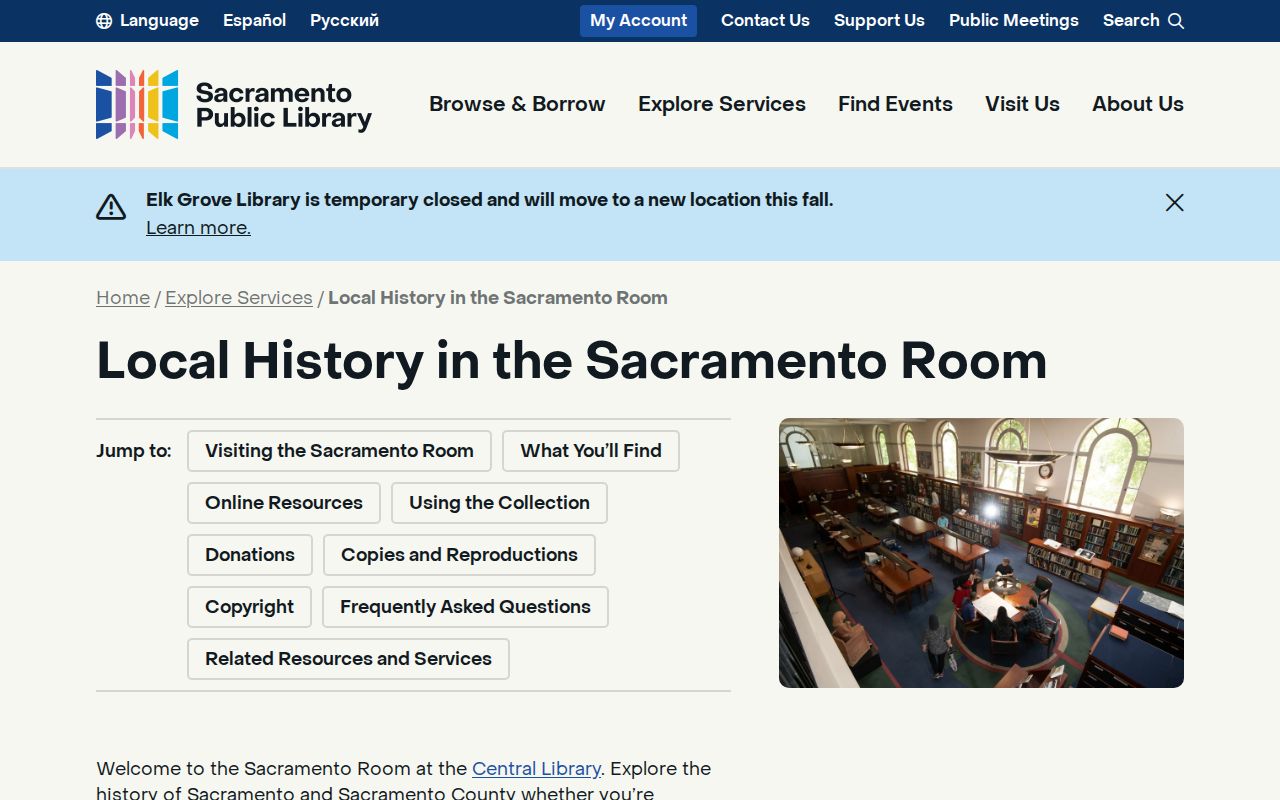
The Sacramento Room capture shows why in-person shelf work remains valuable. The directory may sit beside the map or manuscript that explains a name change, move, or local organization.
Digitized Sacramento Telephone Volumes
The Library of Congress provides free scans of noncontinuous Sacramento telephone directories. Verified holdings include September 1908 through May 1910, April 1916 through December 1917, November 1923 through December 1924, February through September 1931, June 1936 through May 1938, February 1939 through August 1940, December 1941 through June 1943, March through December 1944, September 1945 through June 1946, and later annual or near-annual material across parts of the 1950s, 1960s, 1970s, and 1980s.
Open the Library of Congress Sacramento directory search and inspect the item record before treating a scan as a full city directory. Many volumes are telephone books, so a subscriber can be present while another adult in the household is absent. The scan can still supply an exact spelling, street number, phone exchange, business affiliation, or cross-check for a family-history lead.
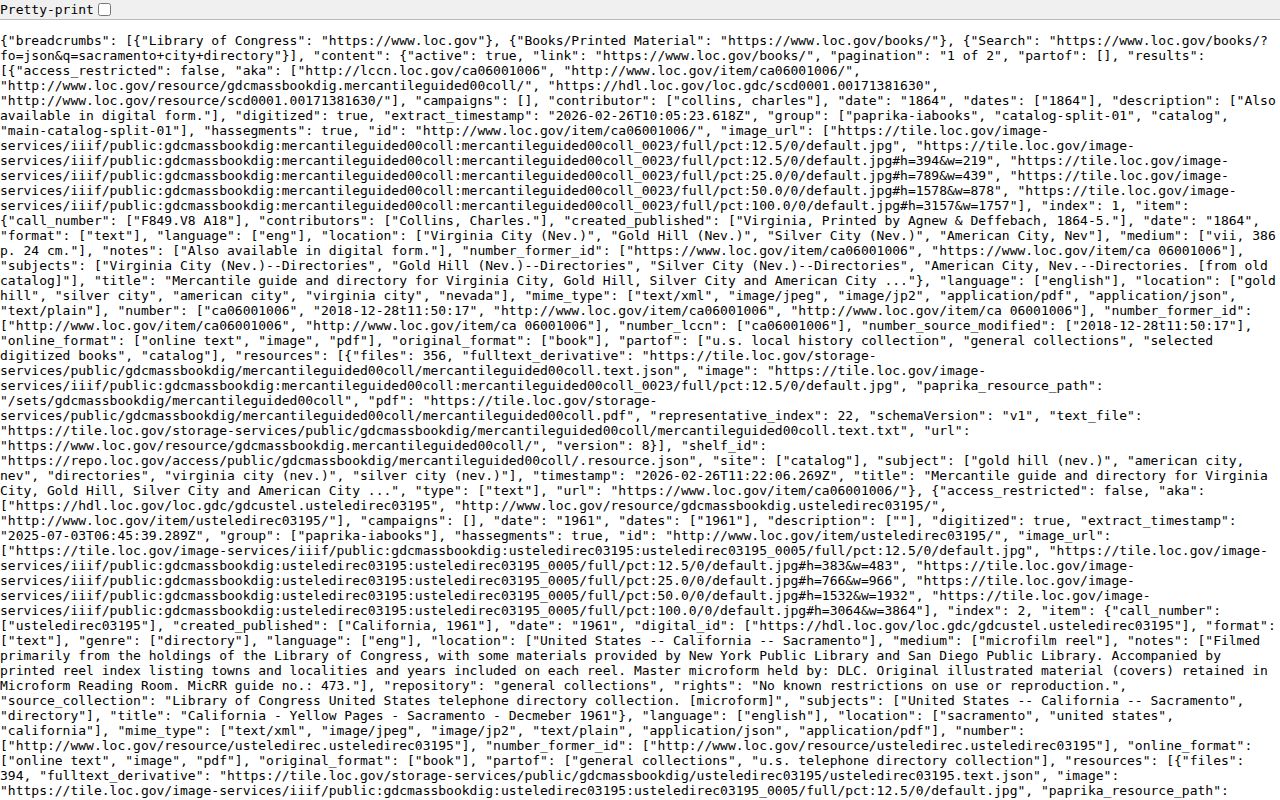
The Library of Congress search capture is a useful digital shelf, but its scattered coverage is part of the evidence. Record the item date and title with every transcription.
How a Sacramento City Directory Entry Works
A city directory entry usually begins with a surname, then a given name or initial. A spouse may appear in parentheses. The line can add an occupation or business affiliation, residence address, business address, and a widow notation. Later editions may place an address-first entry in a street section. Telephone volumes can list a subscriber rather than every adult who used the home.
| Name | Surname and given name or initial, with spelling preserved as printed. |
|---|---|
| Family notation | Spouse in parentheses or a widow marker when the edition supplies it. |
| Occupation | Historical work or business affiliation, not proof of present residence. |
| Address | House number and street; some editions use “r” for residence, “h” for house, or “bds” for boards. |
| Owner or non-owner mark | Use only the symbol explained by that volume's own key. |
- Criss-cross directory
- The reverse, street-order section that starts with an address and may name an occupant or subscriber.
- Householder index
- An address or head-of-household aid that can narrow a search before the alphabetical entries.
- Abbreviation key
- The edition's explanation of short marks; photograph or transcribe it before expanding any term.
From Alphabetical Listing to Reverse Address
When the known fact is a surname, start in the alphabetical resident section. When the known fact is an old Sacramento address, start in the reverse or criss-cross section. Write down the full entry, edition year, address, spouse notation, business line, phone, and any mark that may identify a non-owner or a household transition. Then flip back to the alphabetical page to test the name.
The reverse section is especially useful for a house history because it can catch a listed occupant who never appears in a deed. It is also where a street name change or address renumbering becomes visible. The absence of a name does not prove a move. Check the next edition, a map, a census, an obituary, or a deed before closing the trail.
Yearbooks and Genealogy Add Human Detail
The Sacramento Room holds more than 100 regional school yearbook titles. A yearbook can reconnect classmates, place a student in a year, identify a club or team, and supply a face or spelling that helps a later record search. It is not a current directory. The title, school, edition year, and page should stay with the clue.
The library's genealogy resources include Ancestry Library Edition, HeritageQuest, American Ancestors, Fold3, Digital Sanborn Maps, and Newspapers.com World Edition. HeritageQuest is described as holding more than 4.4 billion records from the 1700s, including census, city directory, military, will, and probate material. Card or in-library authentication applies to several databases. Monthly genealogy lectures provide another way to resolve a hard-to-read volume.
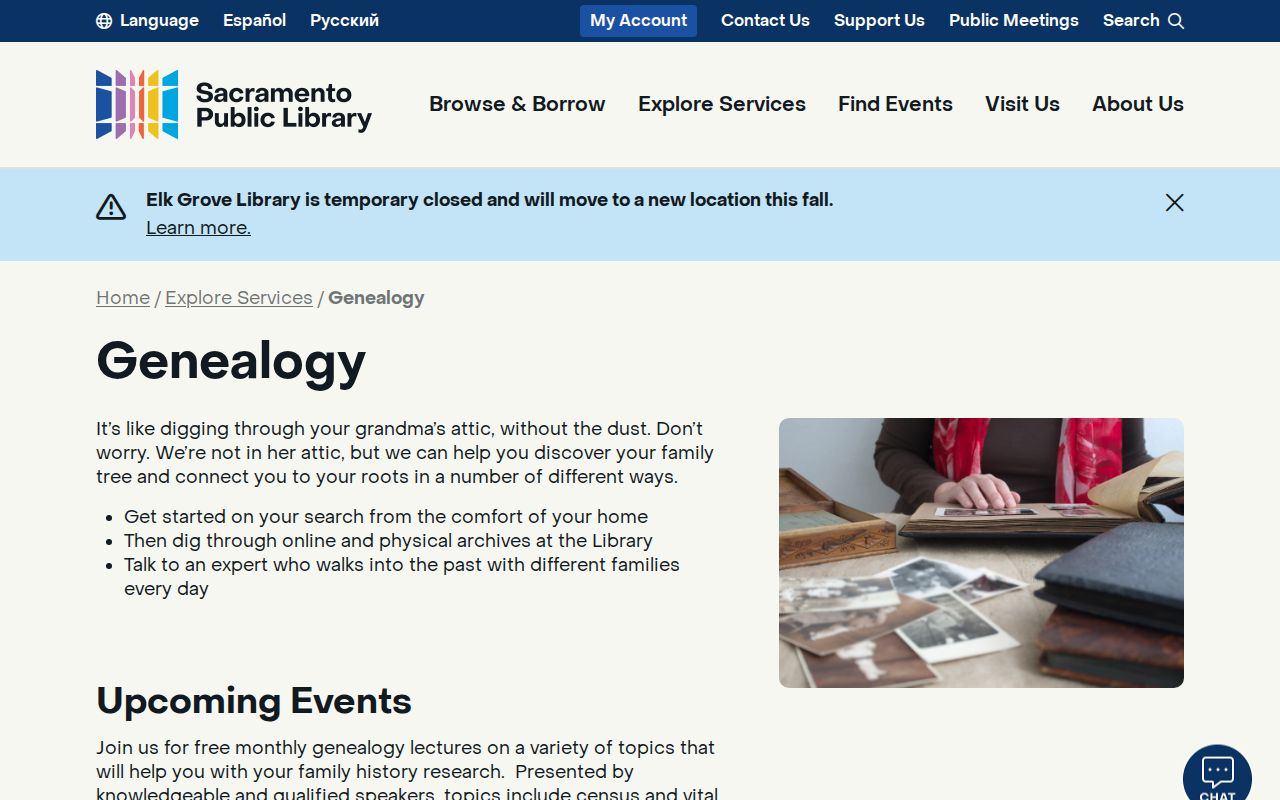
The genealogy capture points to companion databases that can fill a gap between two directory editions. Use the library record as a source, not just a name copied from a search result.
A Sacramento Directory Research Timeline
Sacramento's directory evidence follows the county's growth from a Gold Rush and railroad center into a state-capital region with city, suburban, rural, and Delta communities. A short timeline helps keep different record types in their proper place.
- 1878: An 1878 Sacramento City Directory is cited in federal HABS documentation, but a continuous publisher run still needs catalog confirmation.
- 1895: The Library of Congress Sacramento Sanborn atlas documents buildings on 44 sheets and 85 digitized images.
- 1908 to 1910: A verified Library of Congress telephone-directory span supplies early subscriber evidence.
- 1915 to 1952: State Library references and Digital Sanborn holdings add later maps and revisions for structural context.
- 1950: The newest public federal decennial census pairs with directory work under the 72-year release rule.
The timeline does not turn a map label into a person. Sanborn maps show footprint, construction, materials, and use. Directories show printed names and addresses. Each source answers a different part of the same family-history question.
Pair Names With Maps and Census Years
The 1895 Sacramento Sanborn atlas is free and useful for the building behind an address. Later evidence identifies 1915 mapping with revisions through 1952. LOC coverage also reaches Galt, Folsom, Elk Grove, Isleton, Courtland, Walnut Grove, and other county communities. A map can show a footprint, use, and structural change. It cannot name the person inside.
The 1950 census is currently the newest public decennial census. Pair a directory entry before or after 1950 with the census household, relationships, age, and occupation, then use a deed, obituary, or probate file to test identity. Sacramento's numbered and lettered central grid may make old address browsing easy, while annexed and suburban streets need tract maps and APNs.
Directory Gaps Need a Second Source
Official pages reviewed for Sacramento do not expose an exact volume-by-volume publisher list. The safe claim is that city, county, and telephone holdings exist, that Library of Congress scans are noncontinuous, and that reverse sections should be verified edition by edition. A blank catalog result may mean a gap, a different catalog record, a fragile volume, or a collection held by the State Library, Center for Sacramento History, FamilySearch, or another archive.
Search variants matter. Try initials, married and former names, Spanish double surnames, diacritics, transliteration variants, and corporate or trust forms. Keep a note of the edition's own spelling. If a name disappears, test a move, death notice, probate file, directory suspension, or a change in the way the directory was compiled before calling it a departure.
Using Sacramento City Directories for Family History
A city directory becomes more useful when each edition is treated as one dated observation. The goal is not to fill every year with a guess. The goal is to preserve a chain of exact entries and then test the change with another record.
- Choose a known name, address, or year and write the source, title, edition, and page.
- Read the alphabetical entry, then inspect the reverse section if the volume has one.
- Compare one edition before and after, recording moves, spouse marks, business lines, and spelling.
- Pair the directory years with the 1950 or earlier census and with maps for the same address.
- Use newspapers, cemetery material, probate, or a deed image when the directory trail ends.
When a directory find needs a current identity check, use an official record source rather than stretching the old entry beyond its year. The modern address chain belongs on the Sacramento County street directory page, while a one-person question belongs on the resident lookup page.