
Finding People in Sacramento County
Sacramento County is not a single city. An address can fall in Sacramento, Citrus Heights, Elk Grove, Folsom, Galt, Isleton, Rancho Cordova, or unincorporated territory. That first jurisdiction check matters. It keeps a city permit or code case from being mistaken for a county record. Deeds, assessment, voter registration, and Superior Court cases all stay countywide. Yet each office exposes only one slice of a person or household.
The best resident lookup starts with what is already known. An address points to the Assessor and Recorder. A court matter points to the right case division. Family history points to the Sacramento Room, census material, newspapers, or probate. No single roll proves present residence, though. The useful result is a set of identifiers that agree.
- Normalize the name or address, then confirm the city or unincorporated jurisdiction.
- Use the Assessor parcel map or public roll to preserve the APN, situs address, and mailing address.
- Search the Recorder index, court portal, voter self-status tool, or vital-record channel that matches the question.
- For an older household, compare a city directory, reverse directory, census year, map, obituary, or probate filing.
- When a field or image is not online, keep the document or case number and ask the custodian for the next access channel.
The Offices Behind a Sacramento Resident Search
Sacramento County splits its resident records by function. The Clerk/Recorder indexes land instruments and issues vital-record copies. The Assessor keeps parcel and ownership fields, yet its web viewer leaves owner names out by design. The Elections office controls access to the voter file. Older directory layers rest with the Sacramento Room and state institutions. The functions do not overlap. Each office beats a broad people-search result, because each has a named custodian, clear coverage, and a correction path.
Sacramento County Clerk/Recorder
Recorded documents, marriage and vital copies, and fictitious business names.
(916) 874-6334 for recorded-document copies
Online index plus office, mail, fax, phone, and in-person channels.
Sacramento County Assessor
Parcel maps, values, secured owner and mailing fields, and Recorder references.
(916) 875-0700
Lobby computers, phone or email help, and public-record requests.
Sacramento County Elections
Self-authenticated voter status and purpose-limited voter-file access.
(916) 875-6276 for voter-file access
Written application, identity details, approved purpose, and paid file options.
Sacramento Public Library
Directories, maps, yearbooks, newspapers, manuscripts, and genealogy databases.
Central Library Sacramento Room and licensed research collections.
Vault material is produced one item at a time.
Sacramento's Deep Recorder Index
Depth is the story here. Sacramento County's online index of recorded documents reaches back to 1849. It crosses the county's 1850 statehood era. Deed images still do not display. A result supplies party names, grantor or grantee roles, recording facts, and a document or book-and-page reference. That reference is the bridge to a paid copy or an office inspection.
Treat the index as a land-transaction tool, not a household roll. A deed party might be a seller, trust, estate, lender, or lien claimant. Use it for a person tied to land. The Recorder holds the records themselves from 1850. Copies can be requested by mail, fax, phone, or in person. Noncertified copies run $8 for the first page and $1 for each added page; certified copies run $9 for the first page and $1 for each added page. Wills and divorce decrees belong with the court instead.
| Party name | Grantor or grantee name, searched with spelling and name variants. |
|---|---|
| Recording year or date | One year or a bounded date range, with the index beginning in 1849. |
| Document reference | Book and page or document number for a direct copy request. |
| Document type | Deed, deed of trust, reconveyance, assignment, lien, or another recorded class. |
| Image access | No online image in the index; inspect or order the instrument from the custodian. |
Open the official recorded-document index before calling the copy desk.
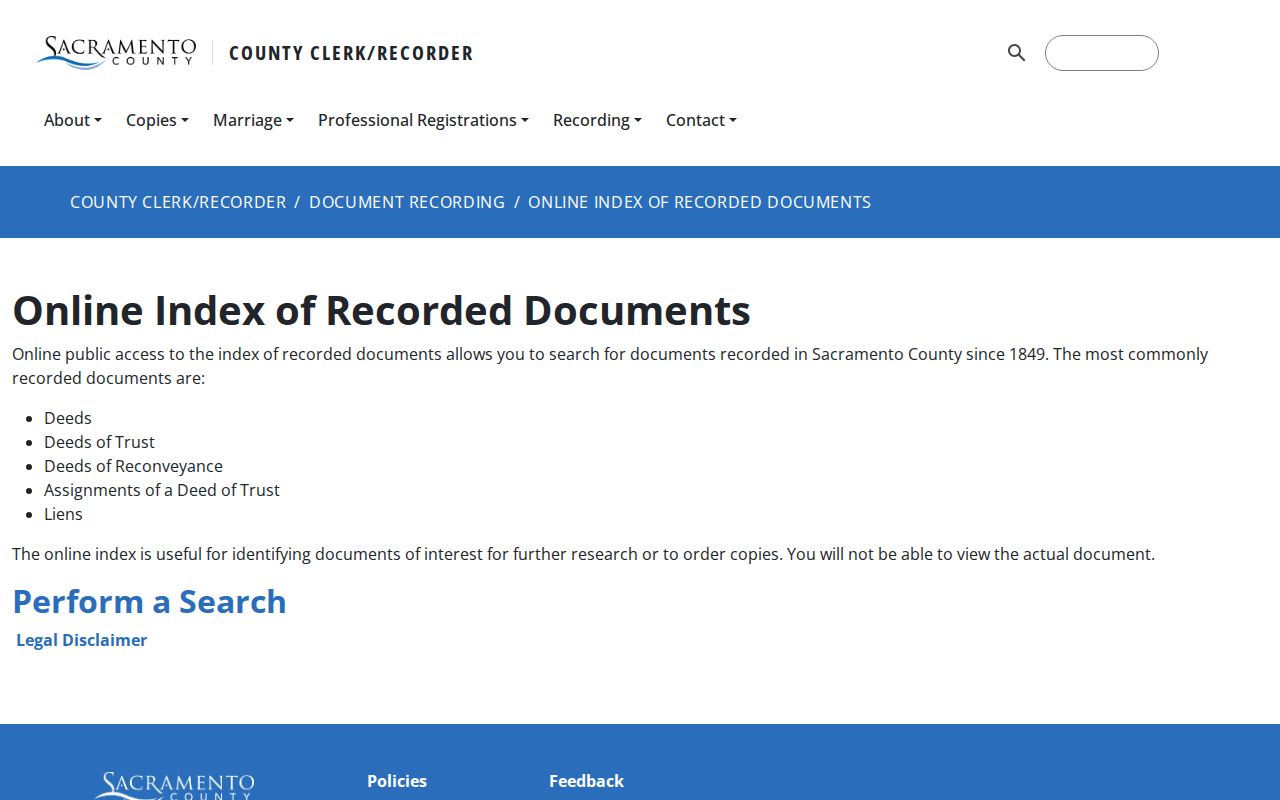
A deed or lien trail starts here. The county's official index page identifies a record, while the Clerk/Recorder supplies the document image through its separate access channels.
Why Sacramento Owner Fields Go Offline
The Assessor's parcel viewer earns its keep before any name appears. Search by address or APN and click the parcel. Save the map reference, assessed value, land-use code, and limited characteristics. Owner names are absent from the web view. The public counter and request channels hold more. Secured owner, mailing address, situs address, exemptions, and Recorder book-and-page numbers are available there.
The Assessor lobby sits at 3636 American River Drive, Suite 200, Sacramento, CA 95864-5952, with computers open Monday through Friday from 8 a.m. to 5 p.m. Staff will handle at most two parcels per day by phone or email when given an address or APN. Electronic records cost nothing through Sacramento County NextRequest. Before treating the map as evidence, revisit the Assessor Parcel Viewer instructions. That split is the point. A free map gives parcel context, while owner research needs the counter or a request.
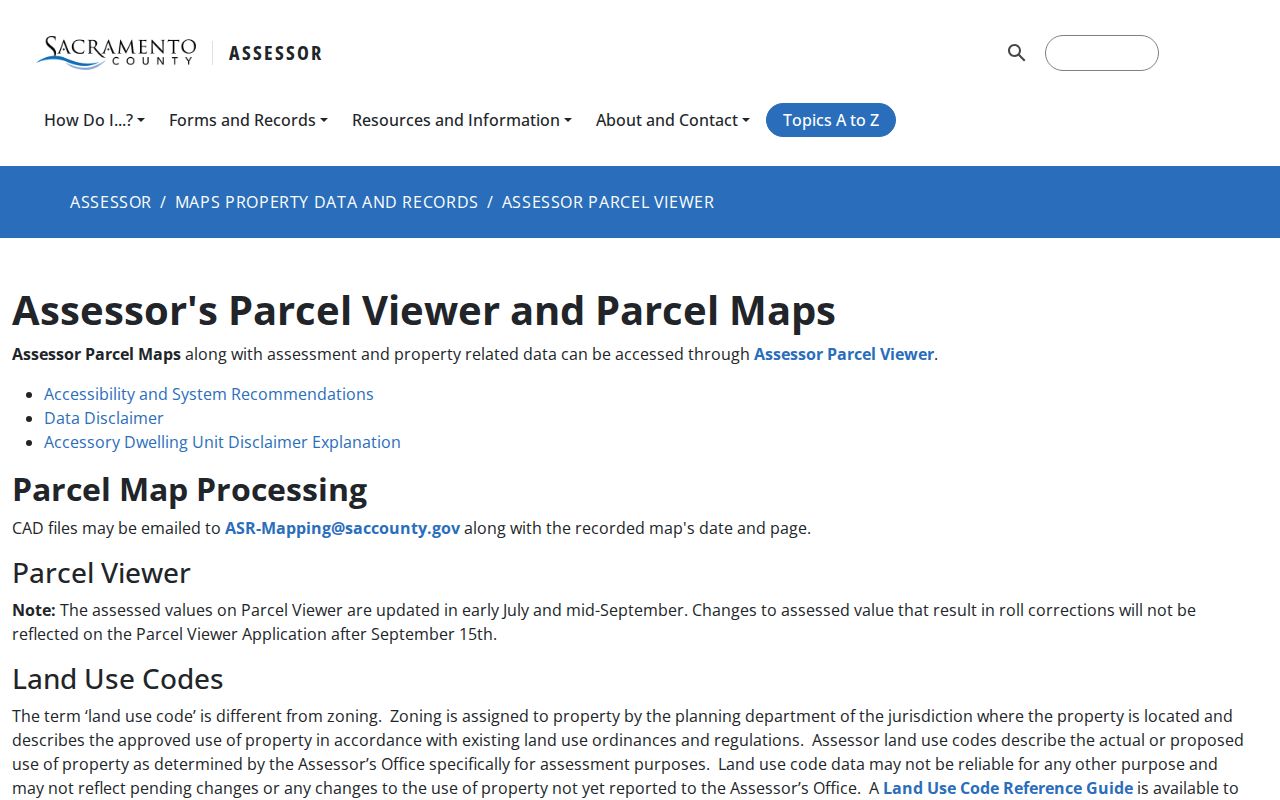
The gateway shows that limit plainly. An empty online owner field does not mean the underlying public roll is unavailable.
Current Sacramento County Residents Directory Sources
Think of a current Sacramento County residents directory as a group of narrow sources. Each row answers a different question. Some rows are only ownership clues. The distinction matters when a mailing address belongs to a trust, agent, business, or other property.
| Source | What It Can Confirm | Custodian | Access |
|---|---|---|---|
| Assessor public roll | Owner, mailing and situs fields, APN and values | County Assessor | Viewer for parcel context; lobby or request for owner |
| Recorded-document index | Parties to deeds, liens, and related instruments | Clerk/Recorder | Free index; paid or office copy |
| My Voter Status | A voter's own status and election details | California Secretary of State | Authentication with identifying data |
| Business, FBN, or license record | Business or professional affiliation and address of record | State or county custodian | Free search with board or filing limits |
| Neighborhood directory | Organization boundary and public contact | City of Sacramento | Public organization entry, not member roster |
Match the source to the claim. The Recorder names a party. But it does not tell you who slept at an address. The Assessor proves ownership. Yet a property record never lists every household member. Proof rarely comes from one office. A resident lookup gains strength when two independent identifiers agree. For a full parcel-to-address walkthrough, see the Sacramento County street directory. Taken together, these sources form a working Sacramento County residents directory.
Sacramento Court Searches Split by Matter
One hub, several doors. The Sacramento Superior Court Case Search hub splits its lookups by matter. Criminal, civil, family, probate, traffic, and small claims each carry their own search mode and rules for pulling documents from afar. Criminal access runs from 1989 forward. Historical civil files cover 1936 to 1995, and historical probate reaches from 1948 to 2007. The newer civil and probate systems ask for an account. A kiosk at the courthouse, though, can sometimes surface public details that the remote courtesy viewer will not.
Treat any hit as a lead, not a match. Exact-name searches return case numbers, the court cautions, and cannot fingerprint anyone. Weigh the case role. Check the filing date, a middle name, and an address clue. Also weigh at least one other official record before you decide two entries describe the same Sacramento resident. Old civil files may sit off-site for roughly 10 business days. Mailed civil-record requests can take four to six weeks. Questions? The civil help line is (916) 874-5522, option 3; probate uses (916) 875-3400, option 2.
Need the file itself, not just the docket? Copy and certification routes exist at the courthouse. A civil staff search past ten minutes costs $15. Pages run $0.50 each, certification adds $40 plus copies, and exemplification adds $50 plus copies. Self-serve copies cost a quarter. These are court fees only; the Recorder keeps a separate deed-copy schedule.
California Voter Status Is Self-Service
California My Voter Status works only for the voter's own record. Enter first name, last name, and full date of birth. Also provide either a California driver license or ID number, or the last four digits of a Social Security number. The result can show registration status and address. It can also show party and language preferences, vote-by-mail or provisional status, polling place, and county contact. It is a self-authenticated lookup. It is not a way to walk a Sacramento street directory name by name.
Elections Code sections 2188, 2194, and 2157.2 limit voter-file access to approved purposes. These cover election, scholarly, journalistic, political, or governmental uses. The California My Voter Status form is the self-service route. A Sacramento file request instead needs a written application and a driver-license copy. It also needs a purpose statement, security terms, and geography or specific-voter details. The county prices an $80 file and a $105 custom file. Activity subscriptions run $308 for four weeks or $616 for eight weeks. Approved paid orders are ready within 72 business hours. Driver-license and Social Security data never leave the file.
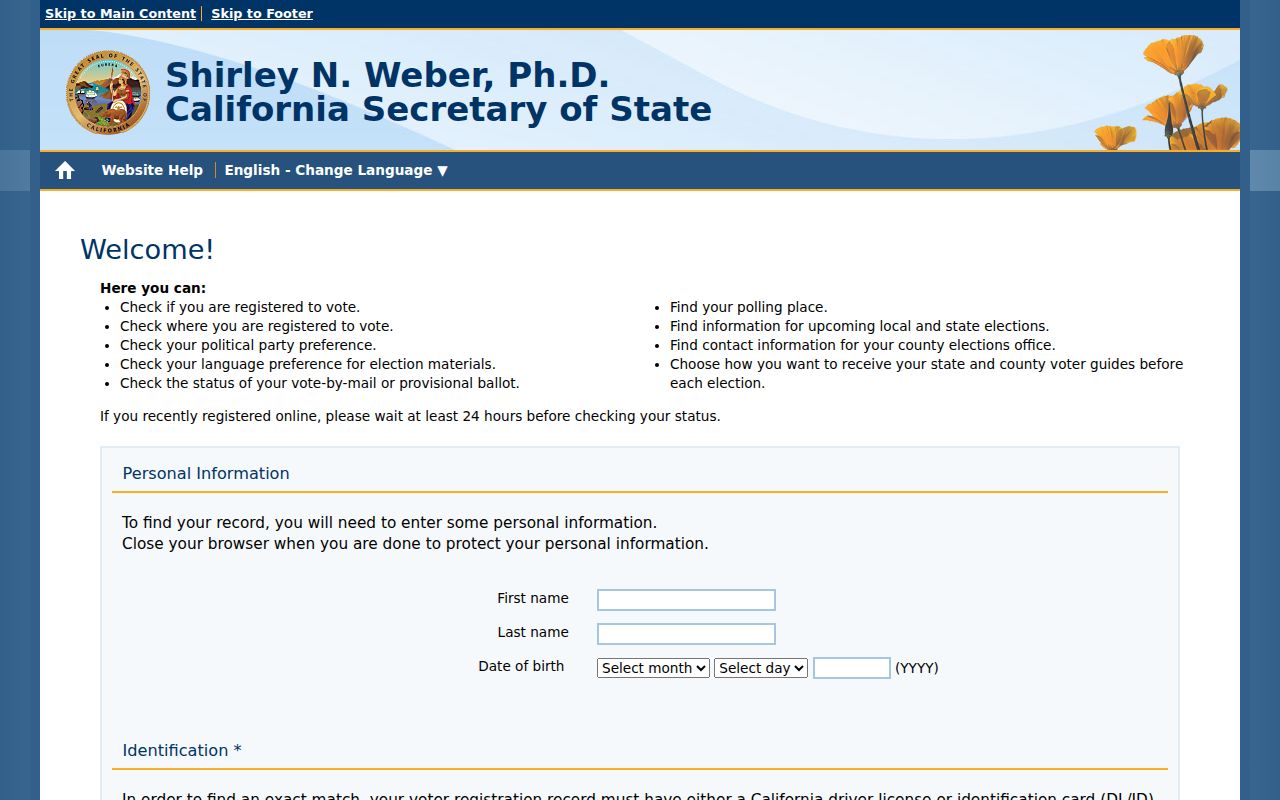
The self-status form shows the boundary clearly. The person supplies the identity data and receives a personal result, while ordinary public browsing by street remains a different service altogether.
Vital Records Need the Right Eligibility
Vital records can anchor a resident search. California does not open them by age alone. Health and Safety Code sections 103525 and 103526 split authorized certified copies from certified informational copies. Eligibility decides which one a requester may receive. Confidential marriage records stay restricted under Family Code section 511. Adoption originals stay sealed. A statute or a court route can open them. Sacramento County routes local birth and death copies through the Clerk/Recorder and county Vital Records channels. A county birth copy costs $34. Death copies run $26, and marriage copies $19. County Vital Records, at 7001-A East Parkway, Suite 650, handles events within the past two years. Walk-in hours run weekdays, 8 a.m. to 4 p.m., with phone service to 4:30 p.m. at (916) 875-5345. When county jurisdiction is uncertain, the state CDPH Vital Records office is the fallback. State fees change on January 1, 2026. Birth copies will cost $31, death $26, marriage $19, and a dissolution certificate $18.
Historical Sacramento County Residents Directory Shelves
The Sacramento Room holds the county's directory shelves. It sits inside the Central Library's original 1918 Carnegie Reading Room. No appointment is needed. An advance email helps staff pull vault material. Holdings span city, county, and telephone directories. Maps run from the 1880s through the early 2000s. The collection also holds more than 100 regional school yearbook titles, plus manuscripts, periodicals, photographs, scrapbooks, and ephemera. Vault items come out one at a time. A library account supports access, and staff may scan or photocopy material when condition permits. The Sacramento Room collections shine for a former classmate, a family address, or an organization missing from a modern roll. Genealogy resources add HeritageQuest, Ancestry Library Edition, American Ancestors, Fold3, Digital Sanborn Maps, and a newspaper database. Some need a library card or in-library authentication. For reverse sections and edition gaps, the Sacramento County city directory archive treats the city-directory shelf in depth.
Other Sacramento County Signals
A few official searches can reconnect a name to a public affiliation, a custody record, or a reported address. They are clues, not a master resident list. Preserve each source and its warning before concluding anything. The Sacramento County Sheriff inmate search asks for a last and first name, shows a custody snapshot, and warns that charges can change. The CDCR locator covers state prison records. The Federal Bureau of Prisons locator covers federal ones. California's Megan's Law site offers name and map or address-area modes after a use-warning acknowledgement. All of these systems carry strict purpose and identity limits.
The Sheriff's site offers a custody lookup, not a household directory. A Sacramento County booking record should never be merged with a same-named resident without more identifying details. The separate California Megan's Law registry can be consulted only when its protective-use rules fit the question at hand.
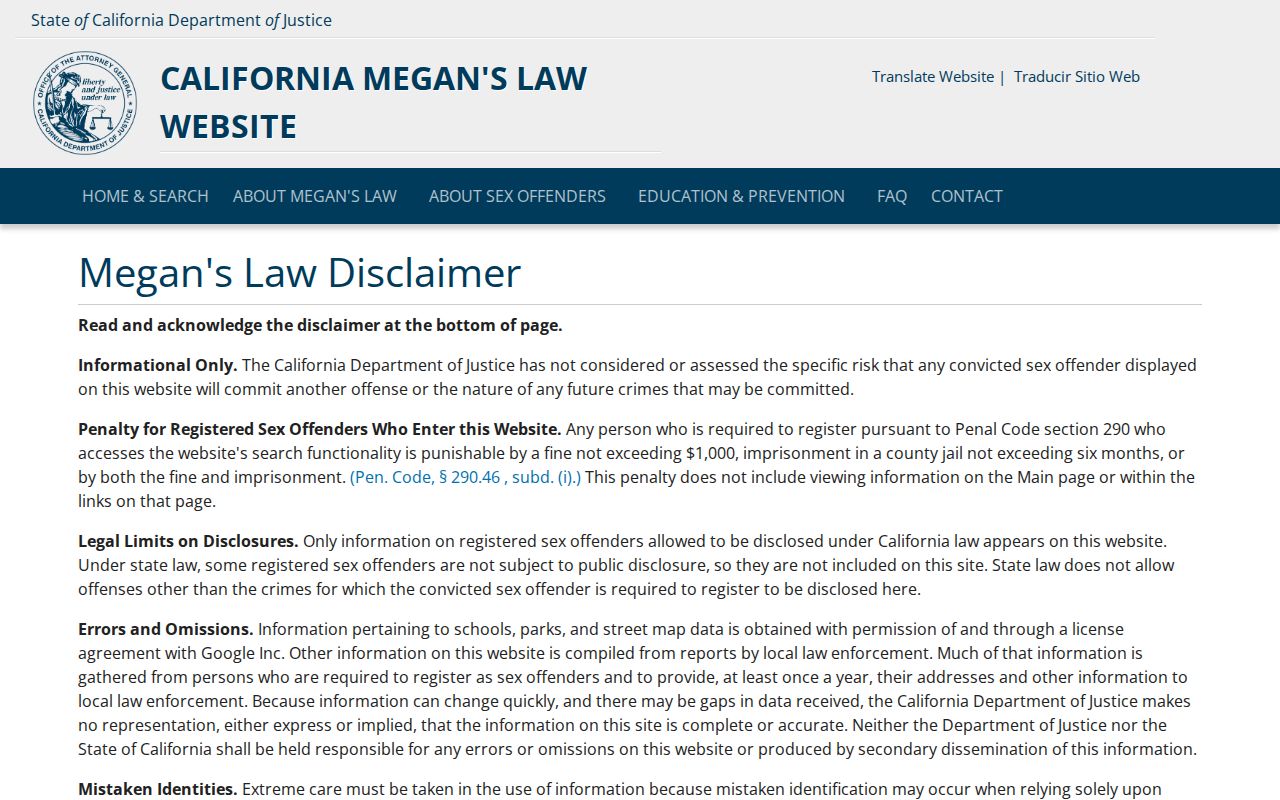
Megan's Law is a distinct public registry with strict conditions on use. Penal Code section 290.46 permits use only to protect a person at risk. Harassment carries civil or criminal penalties. Treat it as a protective tool, not a directory entry.
For business and professional clues, the California Megan's Law registry plays no role. The California Secretary of State Business Search covers corporations, LLCs, and limited partnerships. County fictitious-business-name filings then connect a trade name to registrants and their addresses. DCA license results show an affiliation or an address of record, never a confirmed home.
Business-search results belong in an affiliation check. They can support a name match while leaving residence a separate question.
Safe at Home Changes the Address Trail
Some missing addresses are protective by design. California's Safe at Home program, created under Government Code sections 6205 through 6211, gives eligible survivors and other protected people a substitute address. It also provides mail forwarding, confidential voter registration, and possible DMV suppression. State agencies and courts must generally accept that substitute address. Yet the program cannot erase older public material. Private or federal entities may not have to honor it.
California privacy law also splits government records from data-broker copies. The Delete Act's DROP system is moving toward a single request covering all registered brokers. The California Privacy Protection Agency keeps the broker registry and status information. Deleting a match from a private database changes nothing at the source. The Recorder's copy, a court file, or a lawful public filing stays put. For a correction, contact the Assessor, Clerk/Recorder, court, or Elections office that owns the record.
Use records lawfully. Sacramento County public records support family history, civic research, estate work, and personal safety. Do not use a name or address to stalk, harass, threaten, or harm anyone.
Verify a Sacramento Resident Before Relying
A Sacramento County residents directory result is only a lead. Its identity and date must make sense. Match the role in the record against the claim being made. An owner is not automatically an occupant. A mailing address is not always a situs address. A court party may not be the person you seek. A directory subscriber may represent just one adult in a household. It may not cover every resident at that address.
- Roll
- A regularly maintained list, such as an assessment or voter roll, with a defined custodian and access rule.
- Index
- A pointer to a record, often with names and dates, but not the full document image.
- Parcel
- A mapped unit used by the Assessor; its lines are assessment aids and not a legal survey.
- Criss-cross directory
- A reverse directory that starts with a street and address, then lists a named occupant or subscriber.
Keep the APN, recording reference, case number, edition year, or property ID beside the source URL. That small evidence trail makes any correction or follow-up request far easier.